Linguolab IELTS
Condensed Practice Test
Section 1: Listening
Listening Part 1
You will hear a conversation. Listen and complete the form below.
Community Sports Centre Membership Form
Write NO MORE THAN TWO WORDS AND/OR A NUMBER for each answer.
| Example Name: | Peter Wright |
| Membership Type: | 1 |
| Address: | 2 Road, Northbridge |
| Postcode: | 3 |
| Email: | p.wright@ 4 .com |
| Activities of Interest: | Swimming and 5 |
| Annual Fee: | 6 $ |
| Start Date: | 7 |
| Special Request: | Needs a locker near the 8 |
Listening Part 2
You will hear a lecture. Listen and complete the notes below.
The Impact of AI on the Future Job Market
Write ONE WORD ONLY for each answer.
- Al's influence is often compared to historical 9 revolutions.
- Routine jobs are susceptible due to their 10 nature.
- Al is now a tool that can enhance 11 .
- Growing demand for skills in data analysis, Al ethics, and human-machine 12 .
- Risk of increased income 13 .
- Governments may need to provide a new form of social 14 .
- Education must shift focus from memorization to critical thinking and 15 .
- Individuals must be prepared to 16 multiple times during their career.
Section 2: Reading
Reading Passage 1
The Psychology of Urban Green Spaces
A. The modern city is a testament to human ingenuity, a sprawling metropolis of concrete, steel, and glass. Yet, an increasing body of evidence suggests that for all our architectural prowess, we have a deep, intrinsic need for nature. Urban green spaces-parks, gardens, riverbanks, and even modest tree-lined streets are no longer seen as mere aesthetic luxuries but as critical components of a healthy urban environment. Their contribution to our psychological well-being is profound and multifaceted.
B. One of the most well-documented benefits of exposure to nature is stress reduction. A study led by environmental psychologist Dr. Roger Ulrich in the 1980s was groundbreaking. He found that hospital patients recovering from surgery who had a view of trees from their window required less pain medication and had shorter hospital stays than those who looked out onto a brick wall. This 'biophilia hypothesis'-the idea that humans possess an innate tendency to seek connections with nature-suggests that even passive contact can trigger a physiological response, lowering blood pressure, heart rate, and the production of stress hormones like cortisol.
C. Beyond simply calming us, green spaces can also restore our directed attention. Cognitive psychologist Stephen Kaplan proposed the 'Attention Restoration Theory'. He argues that modern life, with its constant demands for focus (driving in traffic, answering emails, navigating busy streets), depletes our capacity for directed attention. This mental fatigue can lead to irritability and impulsiveness. Natural environments, in contrast, engage our 'soft fascination'-a state of effortless attention captured by things like the rustling of leaves or the movement of water. This allows our directed-attention mechanisms to rest and replenish.
D. The social dimension of urban parks is equally important. Sociologist Dr. Frances Kuo has conducted extensive research in the public housing complexes of Chicago. Her findings indicate a strong correlation between the presence of trees and green areas and a reduction in crime rates. Green spaces provide a neutral, welcoming ground for community interaction. Neighbours are more likely to chat, children play together under supervision, and a sense of collective ownership and informal surveillance emerges. These social ties are a powerful deterrent to anti-social behaviour. This contrasts sharply with barren, concrete-laden environments, which are often perceived as anonymous and unsafe.
E. However, the mere existence of a park does not guarantee these benefits. The quality, accessibility, and inclusivity of the space are paramount. A poorly maintained park with inadequate lighting may feel more threatening than restorative. Similarly, a park that is difficult to access for residents of a particular neighbourhood, or one that is perceived as being 'owned' by a specific social group, will fail to serve the wider community. Urban planners, therefore, face the challenge of not just creating green spaces, but designing them in a way that fosters safety, encourages social mixing, and ensures equitable access for all citizens.
Reading Passage 2
The Enigma of the Great Zimbabwe
For centuries, the vast, mysterious stone ruins of Great Zimbabwe were a source of bewilderment for European explorers and colonisers. Located in the heart of southern Africa, the site consists of a complex of massive, dry-stone walls, the most formidable of which is the Great Enclosure, with its 11-metre-high, 5-metre-thick walls constructed from millions of granite blocks, all assembled without mortar. For a long time, the prevailing colonial narrative, rooted in racial prejudice, refused to believe that indigenous Africans could have built such a sophisticated structure. Instead, theories attributed its construction to ancient Phoenicians, Egyptians, or even the Queen of Sheba.
These Eurocentric theories were decisively debunked by the archaeological work of David Randall-Maclver in 1905 and Gertrude Caton-Thompson in 1929. Their excavations unearthed artefacts, particularly pottery and ironwork, that were unequivocally of local Bantu origin. Caton-Thompson famously declared that the ruins were "the product of a native civilization... showing a genius for building in stone that is the admiration of all." Radiocarbon dating has since confirmed that the main structures were built between the 11th and 15th centuries AD by the ancestors of the modern Shona people.
At its peak in the 14th century, Great Zimbabwe was the capital of a thriving empire that stretched across a vast area of the southern African plateau. Its wealth was built on a combination of cattle husbandry, agriculture, and, most crucially, long-distance trade. The city was strategically positioned to control the trade routes from the goldfields of the interior to the Swahili coast, where goods were exchanged with merchants from as far away as Arabia, Persia, and China. Evidence of this global trade is found in the form of Chinese porcelain, Persian glassware, and Arab coins discovered at the site. This trade in gold, and also ivory, was the engine of the state's power and allowed for the construction of its monumental architecture.
The reasons for the decline and eventual abandonment of Great Zimbabwe around 1450 AD remain a subject of debate among historians and archaeologists. No single cause is thought to be sufficient; rather, a combination of factors is likely responsible. One prominent theory points to environmental degradation. The large population (estimated at up to 18,000 people) and their vast herds of cattle would have placed immense pressure on the surrounding land, leading to deforestation, overgrazing, and soil exhaustion. This could have triggered a famine or made the area unable to sustain its population.
Another compelling theory suggests a shift in trade routes. The rise of new powers to the north, such as the Mutapa state, and possibly the opening of more direct trade routes by Portuguese explorers along the Zambezi River, may have diverted the lucrative gold trade away from Great Zimbabwe. With its primary source of income and political power diminished, the city's elite would have lost the means to maintain control and support the large urban population, leading to a gradual dispersal of its inhabitants. It is also possible that political infighting and succession disputes destabilized the state from within, making it vulnerable to these external pressures. Ultimately, the silent stones of Great Zimbabwe stand as a powerful testament to a great African civilization, whose final chapter is yet to be fully understood.
Section 3: Writing
Writing Task 1
You should spend about 10 minutes on this task.
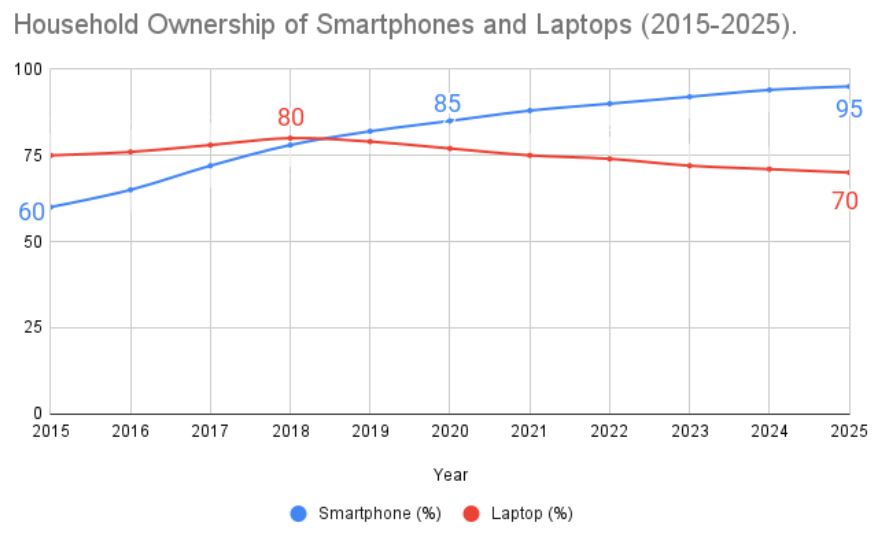
The line graph below shows the percentage of households in a particular country owning a smartphone and a laptop between 2015 and 2025. Summarise the information by selecting and reporting the main features, and make comparisons where relevant.
Write at least 150 words.
Writing Task 2
You should spend about 20 minutes on this task.
Write about the following topic:
In recent years, many companies have allowed their employees to work from home. What are the main advantages and disadvantages of this trend?
Give reasons for your answer and include any relevant examples from your own knowledge or experience. Write at least 250 words.